TCW-359 Teresa Welling
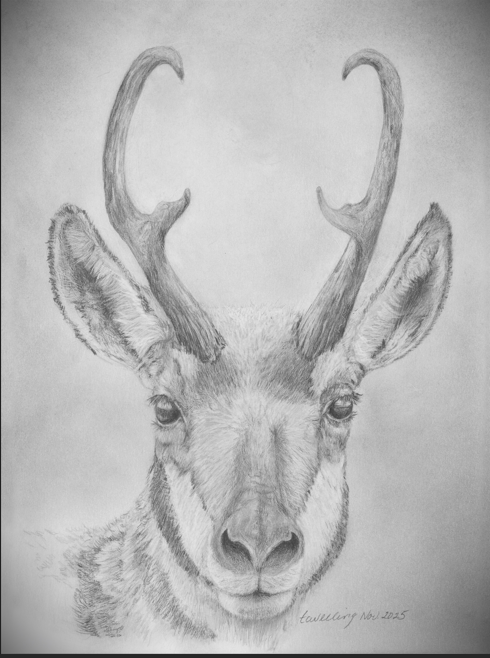
Graphite Pencil Print- "Velvet Eyes" Pronghorn
Graphite Pencil Print- "Velvet Eyes" Pronghorn
Couldn't load pickup availability
Graphite Pencil Print- "Velvet Eyes" Pronghorn
Artist: Teresa Welling
From an original graphite pencil drawing by the artist
A pronghorn stares straight at the viewer.
Choose from:
Print Only
9" x 12" Giclee print
Inside a clear plastic sleeve and on hard cardboard backing for added protection
Ready for a frame of your choosing
Greeting Card
5.5" x 8.5" card with envelope
Blank inside for your personal message
Inside a plastic sleeve for added protection
Send to friends and family
Nice enough to be framed
From the artist:
VELVET EYES: As I spent my childhood and teenage years on a quaint ranch in the
picturesque landscapes of Southeastern Montana, I was often mesmerized by the
sight of herds of antelope grazing peacefully among our livestock in the pastures.
Riding horseback beneath the rugged buttes that loomed to the west of our
homestead, I frequently caught sight of these elegant creatures. The Pronghorn,
with its slender frame and swift grace, captivated me, embodying the wild beauty
of the American West. They were a common and breathtaking sight during my
travels through the diverse terrains of Montana, Wyoming, Nebraska, and
Colorado, each encounter leaving a lasting impression of nature’s artistry.
Pronghorns are unique mammals known for their branched, forward-pointing
horns and remarkable speed; reaching up to 60 miles per hour. The Pronghorn, often called “prairie ghosts”, sheds its forked horns annually and has distinct
warning signals marked by glossy white hairs on their rumps. They have a body
temperature of 100 degrees F, minimal odor as young to evade predators, and a
gallbladder similar to sheep and goats. Males use scent to mark territory and
during the breeding season females may associate with territorial males to deter
aggressive bachelors. While they are commonly referred to as antelopes,
Pronghorns are the only surviving member of the Antilocapridae family, having
evolved alongside the now-extinct North American cheetah. Completed
November 2025.
Share